Vimarsha - India 2021: Hazarding Guesses, Guessing Hazards
Shri Gopal Krishna Gandhi, former Governor of West Bengal, and grandson of Mahatma Gandhi, presented his vision of India in 2021 to an enlightened audience at Vivekananda International Foundation (VIF) on Nov 7, 2011. Crystal-gazing, Shri Gandhi portrayed a kaleidoscopic image of India in 2021 – young, impatient and angry despite a vibrant economy with projected economic growth hovering around eight percent. The growing resources crunch, especially those related to employment, food, water, housing et al could lead to further deepening of the present crisis, Shri Gandhi cautioned. He went on to add that generation of the deprived young and the enriched young would demand a leadership more representative of its age and status.
Vimarsha - A talk on Proposed Communal Violence Bill
‘Vimarsha’, VIF’s monthly series of public discourse on contemporary subjects, was held on September 30, 2011 to discuss an issue of utmost national importance - the implications for social harmony of a proposed legislation titled 'Prevention of Communal and Targeted Violence (Access to Justice and Reparations) Bill, 2011. The talk by Mr. R.N.P. Singh, a former senior officer of Intelligence Bureau, Government of India and currently, a Senior Fellow at VIF, dwelt upon the policy of appeasing minority sentiments at the cost of majority. A distinguished speaker and author of ‘Riots and Wrongs’ - a well-documented book that carries out a comprehensive survey of all communal riots which have taken place in independent India, including the much-talked about communal riot that broke out in Gujarat in 2002 following the burning to death of the hapless kar Sewaks (Hindu volunteers) at Godhara, Mr. RNP Singh highlighted the pernicious provisions of the proposed legislation which are unequivocally aimed at further widening the majority-minority divide in India. The speaker however underscored the fact that the draft bill is an affront to the Indian civilization and tradition which since thousands of years believed in peaceful co- existence and respected the pluralistic values of life. The provisions of Communal Violence Bill take a presumptive view of majority Hindus as killers and shifting to them the onus for all possible future communal violence.
The Study of Ancient India: Erroneous Perceptions and the Reality
In his talk, delivered at Vivekananda International Foundation (VIF) on August 31, 2011, Dr. Dilip K Chakrabarti, Professor Emeritus of South Asian Archaeology, Cambridge University made out a strong case for presenting the history of ancient India in an unbiased manner. The talk, interspersed with powerful arguments, succinctly underscored the colonialist bias from which the study of ancient India suffers even today. It is rather unfortunate that historians in independent India, who have striven to put the records straight, have been labeled either as ‘Hindu revivalists’ or ‘communalists’. Dr. Chakrabarti was speaking at VIF’s increasingly popular monthly event ‘Vimarsha’ on the subject ‘Study of Ancient India: Erroneous Perceptions and the Reality’, attended by a large gathering of people comprising many eminent personalities and scholars from the academia.
Role and Relevance of Saints and Religious Leaders in Constitutional Polity
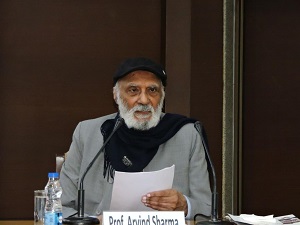
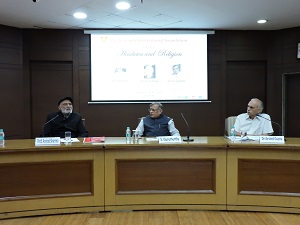
During the VIF’s monthly discourse ‘Vimarsha’, which was held on July 29, 2011, Dr. Bharat Gupt, an eminent scholar of civilisational studies, deliberated upon the ‘Role and Relevance of Saints and Religious Leaders in Constitutional polity’ – a subject which lies at the center of current political debate in our country. Mr. Ajit Doval, Director VIF, presided over the session and also introduced the speaker to the audience.
Maratha Rule 1674-1761: an Appraisal
‘Vimarsha’, the monthly talk at Vivekananda International Foundation, was held on June 30, 2011, on the subject of Maratha Rule in India. Shri Shanti Prasad Agrawal, a scholar of history of Marathas and author of several books, gave an appraisal on one of the six golden epochs in India’s history i.e. the period from 1674-1761 during which Marathas were able to establish their writ over a vast extent of India.
Strategizing Jammu & Kashmir Policy : Factoring in the past Experience & Future Portents
Veteran leader and former Union Minister for Civil Aviation and Energy Shri Arif Mohammed Khan was invited to speak at Vimarsha of April 2011. Shri Khan spoke on "Strategizing Jammu & Kashmir Policy: Factoring in the past Experience & Future Portents".
The talk which well attended was followed by a lively discussion session. Among the eminent personalities who attended the event were Shri Jagmohan, former Governor of Jammu & Kashmir, Shri T.V.Rajeshwar former Director of the I.B. and a former Governor of West Bengal and Uttar Pradesh and Shri Vijay Kapur former Lt. Governor of Delhi.
Globalisation and National Identities
Vimarsha of March 2011 saw eminent scholar of Buddhist and Cultural studies Dr. Lokesh Chandra speak on ‘Globalisation and National Identities’. While introducing the speaker, VIF Director Shri Ajit Doval observed that the selected topic was of great relevance to us – as a nation, as a civil society as well as a civilisation. He indicated the paradoxes of the times when there is plenty of information but a lack of clarity, when there is a plethora of comfort but less of happiness, there is more of speed but less of a sense of direction and finally when there are greater organisations but less of an idea of our collective identity.
India Grows at Night when the Government Sleeps
Vimarsha - A talk on 'India Grows at Night when the Government Sleeps' by Shri Gurcharan Das.
India’s Role in Emerging Paradigm
Salient excerpts of the speech by Ma. P. Parameshwaranji, President of Vivekananda Kendra, Kanyakumari at Vivekananda International Foundation, New Delhi on 25th October 2010.
Paradigm is among those alien idioms which enter our discourse carrying certain baggages with them and limit and condition our thinking. They force us to restructure our thinking, mind set and traditional and inborn character. Being in regular contact with other cultures and nations, this is inevitable. Moreover, unlike in the past now changes are cataclysmic.
Vision India 2025: Need for Legal, Judicial and Constitutional Reforms
VIF Director Mr Ajit Doval welcomed the gathering with an appetising statement that changing situations require new paradigms and increasing conflicts can be resolved through laws. Mr Sorabjee began his talk by outlining the grand vision of the founding fathers of the constitution to eradicate poverty, hunger and exploitation and render justice to all, which are enshrined in the Preamble of the Constitution. He defined governance as the qualitative assumptions about protecting the fundamental rights of the citizens enshrined in the constitution.