VIF Papers
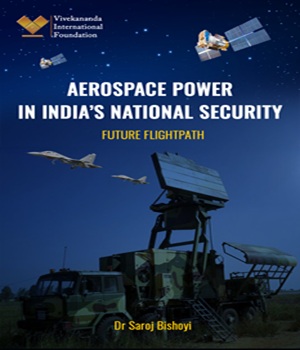
Aerospace Power in India’s National Security: Future Flightpath

After the successful employment of offensive air power deep inside enemy territory in the 1971 War, the hiatus of over half a century during which India’s conflicts were limited to skirmishes on the Line of Control, had led to the strategic effects of offensive air power fading from the collective memory of India’s security establishment. Operation Sindoor brought to the fore the enduring salience of depth targeting in shaping conflict outcomes.

China Harnessing Nature’s Forces and its Implications for India

Back in 1951, when Tibet did fall to Chinese clutches through the 17 point agreement, with that occupation, China gained more than just territory, it acquired strategic control that supported its ambition to become a global power. On the other hand, when Prime Minister Jawaharlal Nehru granted asylum to his Holiness, Dalai Lama, then fleeing Chinese persecution in 1959, India forged an enduring emotional bond with the Tibetans. Since then around 114,000 Tibetans have settled in India.

Chinese Criminal Justice System – An Instrument of Controlling Society

Chinese legal system in general, and criminal justice system in particular has undergone rapid transformation from mere scratch since 1978. During last forty years the Communist Party of China (CPC) have been pledging to develop law-based governance, but increasing criminalization of social actors and intensification of social control system continue to be responsible for the lingering negativity within the legal system in China.

China’s Internal Power Shift: Calm Before the Storm?

Recent incidents have added fuel to speculation. Notably, in May 2025, Xi Jinping was absent from public view for an extended period. There were no public appearances, no editorials in the People’s Daily and no engagements with foreign dignitaries. For the first time in almost twelve years, he did not attend the BRICS Summit. His notable absence has raised eyebrows, both at home and abroad.

Disrupting the AI Order: DeepSeek, Open Innovation and the New U.S.-China Tech Race

In January 2024, a Chinese AI research lab, DeepSeek, released a groundbreaking open-source language model, R1, that rivalled leading Western AI systems like OpenAI’s GPT-4, Google and Meta at a fraction of the cost. DeepSeek’s emergence represents a paradigm shift in the global AI race, significantly narrowing the technological gap between China and the U.S. and triggering global market upheaval. The model’s low cost and high performance have challenged the prevailing notion that only massive compute power and capital investment can yield state-of-the-art AI.

Aerospace Power: Contemporary Geopolitics and National Security

In the 21st century, aerospace power has emerged as a critical determinant of national security and for shaping geopolitics. This paper examines the strategic relevance of aerospace capabilities in modern warfare, and their impact on security framework of nations. The focus is on assessing how the integration of air and space power capabilities influences international relations and global power dynamics. Certain examples from historical and contemporary conflicts bring out the strategic value of aerospace power.

Protection of Critical Information Infrastructure

… digitisation and connectivity of CII have introduced new vulnerabilities and risks to threaten the resilience of essential services ... requires a comprehensive and coordinated safeguard of such infrastructures against cyber threats by a collective effort from government, private sector, academia and international partners...

India and the South China Sea: Upscaling Maritime Diplomacy

… India’s significant stakes are expected to increase in future … regional expectations for a more proactive strategic engagement by New Delhi … China’s dramatically expanding naval forays in the IOR threatens India’s primacy in its prime theatre … imperative for India to further her power projection ...

Geopolitics of Eurasia and its Strategic Significance for India

… Eurasia has assumed greater geopolitical importance … facilitating connectivity and boosting trade and investments are two major requirements … India needs to improve regional engagements and strike an optimal balance between continental and maritime strategies…

Ongoing Crisis in Myanmar and Implications for India

Myanmar's strategic importance for India stems from its shared land and maritime borders, acting as a gateway to Southeast Asia. The ongoing conflict since the 2021 military coup has significantly impacted this relationship. ‘Operation 1027’ and the aftermath attacks since then across Myanmar borders have been a cause of concern for India. Myanmar's internal conflict and presence of armed groups pose security threats to India, particularly its Northeast states, due to the rise in cases of drug trafficking and activities of insurgent groups.

Contact Us